Articles
Turnover in Your Legal Department: How Can You Prepare?
April 27, 2023
Solution
Market Insights

Legal talent turnover and retention are critical concerns for GCs and their legal departments. You rely heavily on the experience and institutional knowledge of your attorneys and legal staff to effectively manage workflows and other legal operations. Considering this reality, GCs have a choice when overcoming departures by mitigating the potential fallout and addressing the underlying causes of employee turnover. Learn key methods of building resiliency from employee turnover within your legal department. This preparation will give you the confidence necessary to lead your team into the unknowns of the legal workforce with a hopeful eye toward the future.
Key Takeaways
- Change Management for your legal department is useful when addressing departing legal talent, budget cuts, or unexpected increases in workflow.
- Legal knowledge management allows for a smooth transition and avoids the risk of losing institutional knowledge to employee turnover.
- Use legal data analytics to know your future needs and create realistic operational plans and contingencies.
- Consider working with an ALSP that can buffer workforce shortages through flexible pay-as-you-go models.
Key Elements of Change Management for Your Legal Department
You can embrace turnover in your legal department by being proactive in your change management, a core competency in legal operations. Change management is about preparing for the future, which includes circumstances like:
- Departures in legal talent due to switching jobs or retirement
- Budget cuts
- Hiring freezes
- New projects or matters
- Evolving with available technology
You can adequately prepare for inevitable disruptions by considering some action items for effective change management below.
Have a System for Legal Knowledge Management
Change management can be especially difficult for legal departments because they rely heavily on their legal talent and personnel to achieve outcomes. When those people leave for one reason or another, it can create significant problems within a legal department in the short and long term. For example, you may have added risk from incomplete critical tasks or loss of efficiency. The simplest method for combatting changes in your personnel is to have a legal knowledge management system.
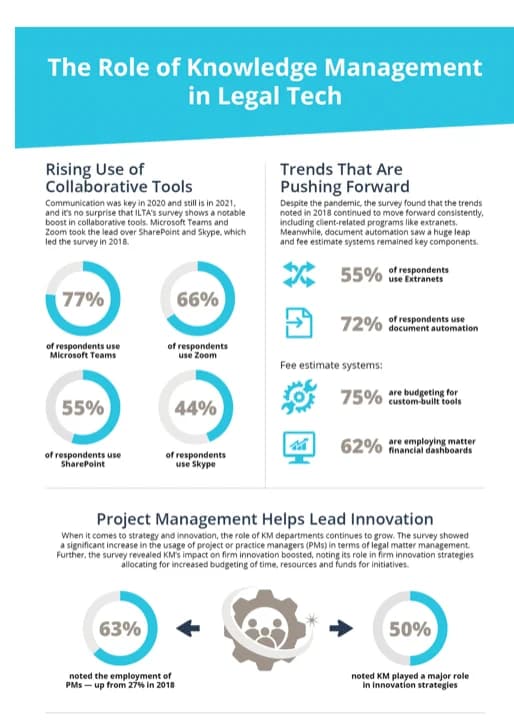
Image Source https://strategiesandvoices.org/Article-Details/infographic-the-role-of-knowledge-management-in-legal-tech-1
What is legal knowledge management? It’s how you retain the wide range of institutional information necessary to keep your legal department running. When considering what information this would include, ask yourself the following question: what would someone need if they were placed in a role within your legal department and had no prior knowledge? Some ideas for developing your knowledge management system include:
- Create playbooks, scripts, checklists, and resources on key legal workflows.
- Use shared email boxes.
- Have a forms database.
Aside from the above list, you also need a system for updating your knowledge repositories when necessary. You can incorporate this function into the duties of your legal staff and have regular check-ins with reporting on updates made and why. You could do this on a quarterly, semi-annual, or annual schedule.
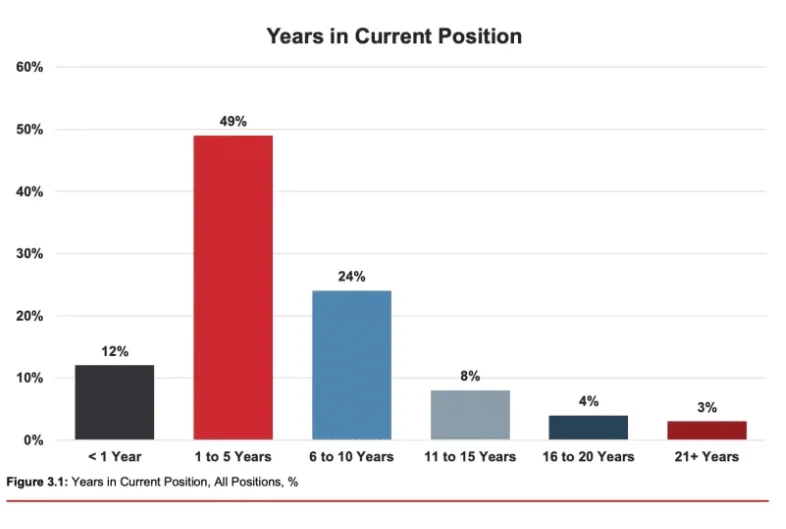
Image Source https://www.barkergilmore.com/in-house-counsel-salary-guide/
Use Legal Data Analytics to Better Understand Future Needs and Turnover Rates
A big part of preparing for the future of your legal department is anticipating future needs. The most effective method for doing so is by creating forecasts. You need current and useful information on your legal department to create accurate forecasts. Here is where legal data analytics comes into play. The following data points may be especially useful in gauging the needs of a legal department:
- The average and median age of your legal staff.
- Turnover rates (how long people keep their positions, how many people leave the department each year, etc.).
- Time it takes to search for, hire, and onboard a candidate.
Consider getting as granular with your data as possible or as is worthwhile. Generally, the larger your legal department, the more granular you will want to be. For example, distinguish your data by key categories like position (e.g., paralegal, junior counsel, senior counsel, etc.) or skillset (e.g., litigation, transactions, IP, etc.).
Create Contingency Plans for Your Legal Workflows
Attorneys are great at thinking through contingencies for their clients. What do you do if x, y, or z happens? The same holds for business planning within your legal department. You need contingencies for your legal workflows and processes if certain events happen, such as a personnel departure or increased workload demand. A contingency plan will likely involve delegating tasks to those best-suited for the job and using outside counsel or ALSPs.
Promote Skill Development in Your Attorneys and Legal Talent
Reliance on your contingency plans in case of shortages and turnover in your legal department is only possible if your staff has the skillset. GCs should offer frequent and thorough training to ensure that staff can handle various legal workflows when needed.
Aside from legal talent changing jobs, this collaboration is also useful in short-term scenarios. For example, covering for a junior or senior general counsel that is sick, on family leave, or vacation. Have a system recording who has done what training, so you can properly assign responsibilities to your contingency plans.
Implement Legal Technology Tools to Automate Workflows
Incorporating contract management systems and other technologies can further enhance your strategy for building a resilient legal department. The benefits of such resources are threefold in the context of change management. Primarily, they automate certain tasks in your legal workflows, reducing the demand from individual members of your legal staff. This automaton also mitigates additional burdens when one team member leaves for a different job. Third, legal tech tools can aid your efforts in knowledge management by retaining key information when disruptions in personnel occur.
Consider a Dynamic Working Model with an Experienced ALSP
An experienced alternative legal service provider (ALSP) is a final resource worth considering. These third-party services help with many legal operations vital to GCs and their legal departments, such as contract management, eDiscovery, and other litigation support. Knowing you have access to an ALSP can provide comfort during shortages in your legal talent or when you rush projects that require additional support.
Morae: A Key Resource in Your Legal Department’s Turnover Management
Morae is a global ALSP that understands the business nature of executing your legal operations. In addition to consulting on your legal department’s current planning, we can also be a key part of your solutions. Our pay-as-you-go working model gives GCs and legal departments the flexibility they need to meet their quick changes in demand. In other words, we are a buffer for the ebb and flow of your projects and staff, so you don’t have to risk making a rush hire or experiencing delays in your projects.
Contact Morae today for a consultation about our services.